Showing posts with label interview. Show all posts

Thursday, May 16, 2013

Loli-con Complex: Azuma Hideo and Aoyama Yuki


Available on Amazon.
If an artisan's touch can venerate obscene materials to the level of art, then perhaps Azuma Hideo and Aoyama Yuki will integrate loli-con aesthetics into the public sphere—or at least keep the censors off their backs for a little while longer. Azuma Hideo, recovering alcoholic and pioneer of the erotic-cute style of manga popularized in the late 70's, recently met with photographer Aoyama Yuki, best known for his tantalizing collections featuring schoolgirls in surreal poses, to discuss their collaboration on a new omnibus of Azuma's works.

Schoolgirl Complex by Aoyama Yuki
On Aoyama Yuki
Azuma:
His photos manage to be erotic without showing the girl's face—that impressed me most. He leads your eye to the minutia, the wrinkles in a shirt, the ratio of fabric to flesh. He focuses on the parts you want to stare at on the train, but can't in fear of being arrested. There's something wholesome about that.

Aoyama:
A photo book is a collection of one panel manga. Each photograph is self-contained. There's no grand narrative, no connectivity, so a single frame needs to tell an entire story.

Disconnectivity is the core of my work. Typically at fashion shoots, the photographer tries to build up a rapport with the girl—“Yes yes, give me more!” But I want to remain removed without creating a relationship. I don't personally know the subject, so I can't ask them to act a certain way. I get more natural poses when I resign myself to their nature.

Likewise, I maintain a disconnect between the subject and viewer with barriers. A chair leg, a window frame, a wall of foreground defocus. Anything to put a visual element between you and the girl.

 Nanako SOS manga by Azuma Hideo.
On Azuma Hideo
Azuma: Everything is ad-libbed while following the classic 4-act structure of beginning-rising action-twist- conclusion. I start with a main theme, then connect each panel with gags to serve as a part of the larger whole. The narrative needs to loop back on itself. It can't be nonsense. The punchline should be logical, even if the logic is self-contained—we're talking science fiction, after all.

Some of my characters have developed a life of their own. Like Nanako and Mia from Scrap Gakuen. They're still tumbling around inside my head, waiting for their roll call.

Learning how to draw girls is an ongoing study. Aoyama's books are a great reference for how skirts fold and shirts crease. My style has changed more times than I like to admit since the 70's, but the fundamentals are the same—a young face with a big chest and fat ankles.

Aoyama:
Puberty introduces boys to girls as an object of sexual desire without providing a way to connect with them. That's why us men are always stealing looks, peaking over our shoulders. Azuma's work contains that same cocktail of sexual frustration and daydream innocence. His drawings manage to be cute and pure despite the grotesque motifs—bugs, poop, violence. His simple lines are purposeful and kinetic, ready to jump off the page.

Scrap Gakuen manga by Azuma Hideo.
On their Trademark Design Element:
Azuma:
The juxtaposition of slender limbs poking out of baggy clothing. Like cardigans or puffy blouses that scrunch up at the sleeve.

Aoyama:
Most of my models are backlit to create a crisp silouette and posed to create depth—for example, partially showing the other leg obstructed by the foreground leg prevents the image from looking flat.
Schoolgirl Complex by Aoyama Yuki.

On Following Trends:
Azuma:
There used to be more classically trained artists drawing comics. These days, everyone is simply a manga artist. Manga artists aren't draughtsmen—they can't draw anatomically accurate human forms. 

We copy from other manga artists. Me, from Tezuka and Ishinomori Shotaro. People copied Otomo when he was big, then Takahashi Rumiko when she was big. Our drawing style shifts with trends because we have no core integrity.

Aoyama:
The same thing happens in the photography world. When Ninagawa Miki made her break, suddenly everyone rediscovered primary colors.


On Keeping It Real
Azuma:
A certain level of abstraction shields my manga from the censors. Setting nude characters against surreal backgrounds or omitting the man during sex scenes helps diffuse the smut potential.

It would be short-sighted to say that my work didn't have any effect on society. But that doesn't mean that I should limit my imagination and creativity because of that.

Aoyama:
You can photograph a young girl eating candy, so long as it doesn't have a stick. Lollipops and suckers are off the table. But what if you wanted to shoot her simply enjoying the treat? I think it all boils down to intent. Is the artist trying to create something lewd, or does the viewer pervert it in thier mind?

We live in the real world ruled by lawsuits so we must think pragmatically. Intent is open to interpretation, so it's the editor's call to decide what is fit to print. Take the recent AKB48 “hand bra” debacle. The photographer and models were just doing their jobs. It was the editor who was asleep at the wheel.

Schoolgirl butt in suku-mizu by Aoyama Yuki.
On What's Erotic
Azuma: 
 I'm taking a community college life drawing class. They sit you down to draw a naked woman, but it doesn't do anything for me. The girl needs to be clothed to get my juices going.

Another thing—girls that ooze sex from their pores aren't interesting either. They leave nothing to the imagination. But take a modest girl. You know she's as dirty as the rest of them behind closed doors. That's where it's at.

Aoyama:
Acting as my own editor, I don't allow panty shots to creep into my work. Spandex shorts only. Think of it like a doughnut. The middle is hollow—no obviously erotic elements at the center—but the outside ring is delicious.
Girl in vending machine by Azuma Hideo.
Azuma and Aoyama have overlapping themes and visuals despite differences in their personal perversions and the generation gap. The phrase "loli-con" elicits a gag reflex in many, but strip away the sexual politics and you're left with a pleasingly soft aesthetic scented with the sweet smell of nostalgia. Even Freud had to admit that sometimes a cigar is just a cigar. How long before the public accepts that sometimes, a lollipop is just a lollipop?

Saturday, June 9, 2012

Alternative Shift Control


Art by Nikibi.

Alternative Shift Control is an Osaka-based collaboration between musician Shogo Yoshikawa and designer Shinsuke Yamaji, aka Catchpulse. Their [36-56] project presents 56 shirts with prints from 36 artists. Each shirt comes packaged with a hardbound art book profiling the contributors.

We caught up with Yoshikawa to get the lowdown on the raddest T-shirt collab we’ve seen in a long while.

Tokyo Scum Brigade (TSB):
Pulling together 36 artists is no small task. What was your motivation for the project?

Alternative Shift Control (ASC):
We'd managed to amass a large stable of awesome artists and wanted a way to get their names out there. T-shirts seemed like the most accessible option. I mean, everyone wears T-shirts, right? Customers think they're getting clothing when they're actually buying art.

TSB:
Almost like a Trojan Horse for good taste.

ASC:
There's a relationship, but at the same time a disconnect, between art, fashion, and music. A crappy band will have cool T-shirts. Or a band with an awesome sound dresses like dweebs. A high-concept design will lack a message.

All artists put their heart into different areas, so it's rare to find that perfect mix. This project aims to be the complete package.

Art by Shogo Yoshikawa.

TSB:
Your designs range from pop street to B-grade trash. Did you have a specific audience in mind?

ASC:
As long as you like alternative art, I'm sure we have something that caters to your taste. There's plain T-shirts for the street kids and more fashionable cuts for the dressy types.


TSB:
Most participants are Japanese, with the rest from Europe and South America. The lack of artists from the U.S. is almost conspicuous.

ASC:
It's not a conspiracy or anything (laughs). We just don't have any contacts in the States.
Touring Europe with bands and producing zines brought me into contact with artists from all around the world. They make up a majority of the book. The rest are friends of friends, along with anyone who showed up on my internet radar.

TSB:
You guys are based in Osaka. I always hear about the Kanto versus Kansai thing, but I don't know how much I buy into it.

ASC:
For the sake of conversation, let's say that the biggest difference is spontaneity. People in Osaka do their own thing without worrying about the static around them. You have all these free radicals bouncing off each other and there's bound to be a reaction. This uncontrollable energy is our blessing, and our curse (laughs).

TSB:
I think it’s great that you incorporate international artists as well.

ASC:
We want to do more work with foreign talent. Outside of Japan, it feels like people have a different take on art, like it’s more ingrained into the average person’s life. It’s hard to make a name for yourself in Japan, and even harder to make a living as an artist.

Don’t get me wrong, I really love Japan, but the scene needs some help. 

TSB:
I think you guys are doing it a service.

ASC:
This project is just the beginning. We plan to keep delivering art for the masses at a reasonable price, in a medium they can understand. Once we build up the momentum, who can say how far we’ll go?


Check out the collection here.

Friday, July 29, 2011

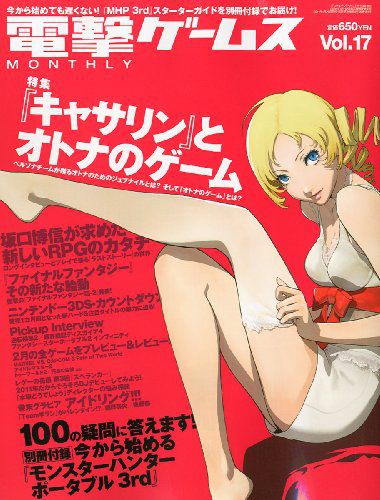
Atlus' Catherine: Long Inverview with Creator Hashino Katsura


Catherine, Atlus’ hotly anticipated quasi-spin-off to the Persona series, has finally hit Western shores with all its naughty bits intact despite the initial hullabaloo over potential censorship. Reviews have been glowing—Finally, a “mature” game that lives up to the moniker without defaulting to insular prepubescent fantasies of sex and violence.

Producer/Director Hashino Katsura steps up to the mic on behalf of all men making plans for their impending midlife crises and explains how dangerously stable girlfriends, a night out with the guys, and Nintendo Hard design sensibilities found themselves joined in holy matrimony to create one of the most unique next-gen gaming experiences ever.

(Interview originally featured in the April 2011 issue of Dengeki Gamers Monthly.)


Games for adults ‘gotta cut to the chase.

-Generally speaking, Japanese games use young protagonists while foreign games feature adults. Any insight?

Hashino (H):The Japanese view adulthood as some sort of bogus trick, all smoke and mirrors. I guess being an adult is pretty bogus when you get down to it (laughs). But on the flip side, this makes us idolize our youthful "glory days."

At the risk of going off topic, those of us in the Famicom Generation grew up with video games there to provide us dreams, and many of us still pick up the controller seeking entertainment. I think this group of 30-40 year olds came out on top in life. I mean, we’ve got all these awesome games waiting for us as we grow old (laughs). Of course, things will be more virtual by that time, and communication tools will be leaps and bounds beyond today’s standards. So while most current games feature youth protagonists, as the Famicom Generation starts aging into its 40’s and 50’s, I think we’ll see more games catering to them over the next 10 years.


-When creating entertainment for adults there’s always the issue of self-censorship of expression.

(H): We wanted to base Catherine around the disconnect between the title’s worldview/characters and erotic elements, with this disconnect as the selling point. This brings up all manner of self-censorship issues, but in the case of Catherine, the characters are old enough that this isn’t a problem, and we’re able to use eroticism as a means of expression. The visuals themselves aren’t erotic… Well OK, maybe they are a bit erotic (laughs).

It’s tough to make the call between erotic and pornographic,but you're not supposed to go into the game looking for that. If anything, I want the player to get pumped up thinking about the unique experience waiting for them in the puzzle segments. It’s better to let your imagination run wild about the other stuff. I mean, we're all adults here.

The common ground adults all share: Love and marriage.

-How did love become one of Catherine’s dominant themes?

(H): The initial scenario called for soldiers on the battlefront sharing a communal nightmare between skirmishes. But then I thought, soldiers? Really? How many people have combat experience?

On the flip side, everyone can relate to the framework provided by a high school setting. It offers these “that’s totally me!” moments. But with 30 to 40 year olds, everyone has different jobs and lifestyles. There’s no catch-all framework. The only common experience that rings true is dealing with relationships.

For adults, romance and marriage creep into all aspects of our life, some more than others. It’s a reoccurring theme of TV shows, but there’s never been a game that tackled it head-on. I knew I was on to something.

-Talking about games and romance calls to mind dating simulations and their ilk. How is Catherine different?

(H): Dating simulations are all about wooing the girl of your choice. Catherine cuts out the smooth talking. You and the heroine are dating from the start. If anything, this time she’s putting the squeeze on you. (laughs) We’re telling the story of what happens after you jump through the hoops and win the girl.

-I’m curious as to how women feel about the game.

(H): We factored that into the equation as well. When we had our female staff sit down with it, the littlest things Vincent did would set them off. “I hate the way he’s always talking down to me!” and so on. After their critique, I’d ask them if they could forgive Vincent for having an affair, to which they responded, “A one night stand means he’s out the door!” (laughs)

We massaged Vincent to be more amiable over the course of development, but apparently not amiable enough to get away with sleeping around.

-Did the female staff help come up with the selectable e-mail responses you send to your girlfriend and mistress?

(H): To some degree, yes. But at their heart, the e-mails are structured like a guy’s mind. (laughs) Even so, our female staff had a blast playing these segments. Telling you girlfriend “I’m at work” when you’re really drinking at the bar with your mistress opened up a portal to another world. It gave them a rush.

-Naturally males and females have different reactions to the game, but what about the married man and the single guy? I can imagine much of it hitting home, and perhaps even below the belt for the former. How would the latter take it?

(H): While every one’s take on the game is different, there’s always a certain element that draws them in. No one’s immune to love sickness, so even though the content may be questionable (laughs), the barrier to entry is low.

-Judging from reviews and feedback online, a segment of gamers feel repelled by titles with romantic elements. They want their games to be straight fantasy, almost as if they’re afraid that otherwise it’ll come back and bite them in the real world.

(H): That’s precisely why the protagonist doesn’t follow the Persona model—He’s Vincent. Not you. Making the player a spectator helps lessen the blow. And although you mentioned that some fans don’t want their games to be serious business, I don’t think that’s the case. Catherine's story isn’t totally grounded in reality. It’s more of a dreamlike vignette that ties up neatly at the end. Even without the romantic element, the game still stands on its own merits.

-Your decisions over the course of the game dictate your ending. I can see how the player’s bias towards love and the opposite sex could shape their destiny.

(H): That’s one of the interesting things we tried to do with Catherine. Be you married or single, people flock towards romance aptitude tests. (laughs) You hear people joke, “Hey baby, what’s your sign?” A better question would be, “What’s your ending?” At the very least it’s great bar talk.

Jerks get all the chicks

-Let’s talk about the characters. Vincent isn’t your standard hero by any stretch of the imagination. Why make a dopey dude the protagonist?

(H): We were aiming for a “sexy loser” kind of vibe. The sort of guy whose wishy-washy and can’t commit, but eventually does deal with his problems, albeit in his own roundabout away. It’s easier for the players to project themselves.

One thing I was adamant about: He needed to be a snappy dresser. If he looked like a shlub I figured no one would buy the game. (laughs)


-That sounds just like Vincent Gallo’s character from Buffalo ’66.

(H): Gallo was the model for our Vincent. He’s the perfect example of a guy whose actions back up his cool posturing.

-Who was the girlfriend Katherine based on?

(H): Stop me if you've heard this before: A guy's been dating his girlfriend for so long that he can’t remember how or why they started, but she’s beautiful, and everyone’s jealous of him for snatching her up. She’s a straight shooter with a respectable job. Other people say “Dude, she’s hot, what’s stopping you from marrying her?” But once they hear about what goes on behind closed doors, they clap you on the back and sigh “Man, that’s rough.” Katherine is a reflection of this.

-How about your mistress Catherine?

(H): There’s no tiptoeing around it—Young girls are attractive. Not only is Catherine sexy, she knows exactly what to say to us “young old men” in their 30’s-40’s, making her an ideal catch. She’s a day dream come true. Imagine what it would be like for this sweet young thing to make a pass at you. Just to give you a peek into my creative process (laughs).


-Vincent’s friends are quirky and unique. Did you pattern them after adult male archetypes?

(H): There was a resurgence of weddings right when we started work on Catherine. Prior to that, the dominant philosophy was “Men don’t want to marry.” Then all of a sudden it shifted to “Everyone get married!” This clashed with the theme of the game so I hoped it would all quickly blow over. (laughs)

Reading books and magazines during this period, I found examples of men who either couldn’t take the plunge or be bothered to marry. These guys form Vincent’s entourage. The four of them spend their time shooting shit at the bar. I couldn’t help but think to myself during production, “If these were the protagonists from Persona 4 they’d have something more upbeat to say.” (laughs)

-You mentioned that Vincent and his crew get together at the bar Stray Sheep. Where did the idea to base the game around a watering hole come from?

(H): Going back to the romance angle: What place do all adults have in common? More ambitious people might be active after work, or go experience nature on the weekend, but most end up simply going out for drinks. I decided on your run-of-the-mill corner bar, the kind of place you drop by because going back home is such a drag.

-Now that you mention it, although the setting is outside of Japan, it feels somehow familiar.

(H): Whatever impetus there was to make the cast non-Japanese was so trifling that even I can’t remember why. I must have had Vincent Galo on the brain. That reminds me—When I first decided to make the protagonist a cool adult, I faltered between either Vincent Galo or Paul Newman. But Paul Newman’s pretty far up their in years, so I gave that part to Boss, the barkeep.

His friends are named after Hollywood heart throbs—Jonathan is Johnny Depp, Orlando is Orlando Bloom, and Tobias is Toby Maguire. (laughs)

The “Nintendo Hard” of next-gen gaming


-When Vincent falls into a nightmare, the game transforms into an action/puzzler. How did you hit upon this unique mix?

(H): The Persona Team messes around with their own pet projects once the latest game is in the can. A climbing box puzzler was one of them. Originally created five years ago, it was shelved because machine specs at the time couldn’t support it in true 3D and it was too simplistic without a story to back it up.

When production on Catherine began, I got the idea to create a world based upon the logic of this mini-game. Struggling hand over fist in your climb upwards—It gelled with the story.

-Why did you include adventure elements, rather than leave it a simple action/puzzler?

(H): I thought that by capitalizing on our storytelling skills in a genre outside of RPGs we could broaden our range as game makers, which is part of the reason we took a crack at an action title.

-Catherine is different than anything you’ve done before. Did you have trouble balancing the difficulty?

(H): People that get it, get it, and people that don’t never well—We don't run into this situation when crafting RPGs, which made things crazy hard.

During the first incarnation, block placement was random, meaning no prescribed solution. The player would have to stumble their way through with what they had and gradually make their way upward without fully realizing how they did it. And while this trial-and-error style game play was satisfying in its own right, we found out that it just didn’t click with some people, hence the decision to create stages with defined solutions.

By the way, the Japanese trial version uses randomly placed blocks, so it’s closer to the true spirit of the game. It was so wicked that the only way to see the ending is to look it up on Youtube. (laughs)

Let me put it this way—We had 20 debuggers testing the final stage, and only one of them cleared it. And only two of our highly trained developers were able to clear it, myself not included!

-At first it seems impossible, but each session brings you closer to that breakthrough. The sense of satisfaction from getting better the more you play reminds me of games from the Famicom era. I think that’s another turn-on for adult gamers.

(H): During the first play, you’ll get flummoxed wondering why you can’t figure it out. Then as you progress, the in-game hints show you new ways to approach the puzzles, only to let you hit another plateau later on. And another after that. And another after that… That trial-and-error process is a lot of fun. It’s like gnawing on a bone to get to the marrow.

The puzzles aren’t all about reflexes and skill. You need strategy, serendipitous luck, and instincts. There’s no single solution to a stage, and finding your own way is half the fun!

With thanks to Dengeki Games Monthly for running the original Japanese interview.

Wednesday, May 19, 2010

TSB gets Prolly'd!

Image lifted from courtesy of prollyisnotprobably.com

On the very day I planned to email Koenji-based figure maker Velocitron about doing an interview, I find out on the Mishka bloglin that we've been beaten to the punch! It turns out that Hell's fixed gear ambassador, John Prolly, already did a very good job of it on his blog. Among the topics discussed are manga (never expected to see Tsunozou Murotani in anyone else's favorite mangaka list!), horror movies and the vinyl figure business. If you like any of the three, you owe it to yourself to READ IT HERE.

Thursday, January 21, 2010

The Joys of Cooking... With Insects(Part II)


Be sure to check out Part I for pictures and descriptions of the food!

Once the dishes were cleared and the excitement had died down, we sat down with Mr. Uchiyama to help make sense of the whole situation. He was accommodating and jovial, a geyser of positive energy bubbling below his cool exterior. For his seemingly eccentric eating habits, he was more in touch with the world than all the "normal" folk living amongst Tokyo's concrete jungle.

TSB (T): How did you get started as an insect chef?

Shoichi Uchiyama (U): I grew up in Nagano where bugs were always on the menu, though not by my choice (laughs). When I moved to Tokyo with my family, my days of snacking on grasshoppers stayed behind in the countryside. Then, around 10 years ago, I happened upon a special event at the Tama Zoo featuring edible insects from around the world. That first crunchy bite brought my childhood memories flooding back to me.

Reconnecting with my youth gave my life a new direction. I practiced on my own, discovering what was delicious and what was vile by trial and error. Around 3 or 4 years ago I went public with my blog. The overwhelmingly positive reaction spurred me forward to treat this as something more than just a hobby.

T: I can’t imagine starting from scratch. What sort of failures have you produced over the years?

U: Grubs are impossible. You see them all fat and juicy and think they’d be the perfect ingredient, while in reality they just turn to mush! They spend their lives eating rotten debris underground and this diet is reflected in the taste. Trust me, grubs aren’t worth the effort.

T: Have you ever had any problems eating things that were best left under the log?

U: Most people assume that wasps and spiders are inedible because of their venom. In reality, all it takes to detoxify them is a red-hot skillet. Yes, the heat actually nullifies the poison! Blister beetles are the arsenic of insect cooking. They secrete a nasty chemical called cantharidin that you don’t want anywhere near you.

T: Your online niche is spreading into mainstream magazines and television appearances. Why the surge in popularity?

U: People have gotten sick of looking up at skyscrapers and are ready to look down at the world at their feet, to get back to their roots. Japan’s realized that it’s over-dependent on imported food, and self-sufficiency has become a real issue. If we’re farming our own vegetables, why not our own protein as well? Wasps are an excellent source of amino acids.

Think of all the food that goes to waste around you: Cicadas dying at the end of summer, grasshoppers in the fall. And stop using pesticide on wasps and ants, it makes them inedible! Exterminators could run a lucrative side business vacuuming up these so-called “pests” for resale.

T: You need a celebrity backing you to get the word out.

U: They let me go toe-to-toe with television personalities but no one takes what I’m doing seriously. The shock factor is still too great for most.

T: If herbivore men are passive, and carnivore men are aggressive, then what are insectivore men?

U: They don’t have any taboos regarding food and are interested in new things. They place a high premium on healthy living.

T: Your current venue, Yoru no Hirune, can only host around 20 people. Do you plan to expand in the future?

U: Right now we have a hothouse culture. The small membership keeps us close and our passion for what we do fuels each other’s fire. You’ll never find a more varied group. One guy is a monkey tracker, this guy hunts wild boar, and the nice lady who provided today’s cockroaches is a translator of Latin.

T: It feels like one big extended family.

U: I wish more parents would bring their children! Kids aren’t as prejudiced as adults and would be more keen to the idea of eating bugs. More zoos should hold insect-eating festivals like the one that got me started 10 years ago.

Of course, my work can only reach so many people in Japan. I’ve published a cookbook of Japanese insects, but I’d like to put out an English version tailored to the arthropods of Western countries.

T: Thanks for the grub!

Sunday, December 13, 2009

Kazuo Umezu VS TSB (Part 1)

(The following is the first of a five-part interview with living legend of manga, Kazuo Umezu, whose works released in English include Cat Eyed Boy and the award winning Drifting Classroom. Our event coverage on Same Hat! caught the attention of his official homepage's staff, who then contacted us directly about helping to produce information about the author for the benefit of his English speaking audience. At the end of November, we were invited to the infamous Makoto-Chan House, his recently-completed home and physical embodiment of his vast works, for a face-to-face talk with Umezologist Demerin Kaneko and the man behind five decades of mayhem.)

Part 1: At the Mountains of Madness

TSB (T):You’re a celebrity in your home country. Compare this to the situation abroad where people familiar with your works don’t know much, if anything, about you as person.

Kazuo Umezu (K): If you’re not careful with the layout of a book people will gloss over the author's name. When possible, I like the publisher precede my bio with a head shot. That way, when they open the book they can see, “Hey! This is the guy!”

T: Tell us about your childhood.

K: My birthplace in the Wakayama prefecture around Mt. Kouya is now a World Heritage Site! I spent my early days deep in the mountains before enrolling in elementary school. When I say deep, I mean deep. There were no shops, no candy stores, no restaurants. I didn’t know that money existed! There wasn’t even so much as a barber shop—my father cut my hair with an electric trimmer.

T: How was it growing up surrounded by nature?

K: Everyday was a beautiful panorama of green. But without any shops, I couldn’t pass the time like most children did. When I was seven months old, my mother got it into her head that I had latent drawing ability. She put a pencil in my hand and showed me how to draw a circle. Lo and behold, I was pretty good at it! Not that I remember any of this, but my mother soon had me doodling flowers and things, pushing me down the path of illustration.

Baby Kazz and his mother.
T: You started with landscapes and scenery.

K: Especially mountainscapes! She had me read technical manuals to learn how to draw properly, then put me to work practicing. I can’t remember a time when my pencil wasn’t running across the page.

Drawing was the only way to keep myself occupied in the mountains. Whenever my family moved, which was often, my mother would send me out onto the porch to draw. Much to my surprise, the children from the village would gather around, and I’d make friends that way. I was always moving and drawing, moving and drawing.

T: Your entertainment options were limited.

K: Instead of watching television in the evening, my father would turn off the lights and tell me scary folk tales. I hung onto every word, laying in bed shaking with fear. I couldn’t get enough! My early manga about snake women came from my father’s ghastly tales.
Showing off his illustrations in high school.
T: Horror took root in you at a very young age.

K: When I decided to become a professional manga artist, I focused on horror because there wasn’t any out there. Armed with a framework, the next step was fleshing it out. What is horror, anyway? I didn’t know the answer myself, so I stuck to what I knew personally found to be the most horrifying—the creepy folklore my father tormented me with!
The Cat Eyed Boy and the One-Legged Monster of Oudai
T: The prototype for urban legends.

K: They were mountain legends to us. Aside from the Snake Woman stories, there’s also The One-Legged Monster of Oudai from Cat Eyed Boy. Many of my stories slithered down from the mountains.

T: The physical darkness of the mountains permeates your work as well. Your excessive use of black ink is unique.

K: That darkness is a part of me. Living in a world without streetlights allows you to understand the true meaning of utter darkness. White indicates a lack of matter, while black shows an abundance. It makes you think that something is lurking just beyond, hidden in the blackness. We all know that there aren't any monsters or snake women lurking in the shadows. But the darkness creates the possibility that they might be!
The Snake Woman from Reptilia. (Hebi Shōjo.)
Demerin: When you flip through weekly anthologies, you can tell which story is Sensei’s because the page is drowning in black.

K: The guys selling ink must love me! (Laughs.)

Part 2

Saturday, December 12, 2009

Kazuo Umezu VS TSB (Part 2)

(The following is the second of a five-part interview with living legend of manga, Kazuo Umezu, whose works released in English include Cat Eyed Boy and the award winning Drifting Classroom. Our event coverage on Same Hat! caught the attention of his official homepage's staff, who then contacted us directly about helping to produce information about the author for the benefit of his English speaking audience. At the end of November, we were invited to the infamous Makoto-Chan House, his recently-completed home and physical embodiment of his vast works, for a face-to-face talk with Umezologist Demerin Kaneko and the man behind five decades of mayhem.)

Glossary 

Kashihon (literally “loaner books”) were manga published largely out of Osaka that were available only for rental, not purchase. This business model died out in the mid 70’s, but the concept lives on in the form of manga cafes and rental chains such as Tsutaya which have recently begun handling manga.

Gekiga (literally “dramatic pictures”) is a style of manga that explores adult themes and uses panels to create a cinematic sense of time passing on the static page. Their self-contained nature allowed them to be highly experimental and was a perfect match for the Kashihon format.

Part 2: Baptism

Tokyo Scum Brigade (T): You were with manga during its infancy and watched the medium mature.

Kazuo Umezu (K): There were countless titles on the market at the time I made my debut, such as Tako no Hacchan and Norakuro. Growing up during the war, most stories were about soldiers and grit.

T: The cartoony art was grounded by the realistic stories.

K: I started taking manga seriously in the fourth grade. My friends lent me tons of titles and I remember thinking, “This art stinks! If this stuff passes off as professional, I’m a shoe-in!”
My first work was titled The Magic Pot (Mahou no Tsubo). I can’t remember the plot, but it was filled with cheap gags. My next few projects copied the model I made for myself.
The following year Osamu Tezuka released New Treasure Island (Shin Takara Jima). 

You know those open-air stalls they have at summer festivals with all the toys and masks laid out on the ground? I ran across it at one of those and it blew my mind! I didn’t know that manga of such caliber existed. That was another thing that made me want to go pro.
At the time, manga was dismissed as pulp. Not that the situation has changed much. Manga was plentiful, cheap, and I read my fair share. 

The range of titles I read before discovering Tezuka gave me a sharp eye for manga. When I saw New Treasure Island at the festival, I knew instinctively that it had to be good. My eyes have never let me down!

T: Early manga was written for children and was mostly juvenile. 

K: This is true, but Tezuka’s creativity set him apart from the pack. He introduced elements that were largely foreign to manga at the time, such as robots and rocket ships. Children ate it up. 
He inspired a generation to become manga artists, myself included. If your drawings didn’t look like his, companies wouldn’t pick up your work. So at first I drew characters Tezuka-style, cartoony with circular faces. Once I got popular I was able to do my own thing.

His style begins to shift from Tezuka to Gekiga with works such as The Fractured Man. (Hibiware Ningen.)
T: Your early sci-fi work, Another World (Bessekai), used similar fantastical elements.

K: The style of early manga was very different than the Gekiga which emerged from it. Gekiga takes place in the "real" world and revolves around action. Traditionally, the point of any manga, regardless of the style, is to challenge the unreal. How far can your work surpass reality?

This doesn’t merely apply to plot, but to illustration and design as well, such as giving characters impossible features like circular faces and bug eyes. This cartoony world formed the bedrock of the medium.

Gekiga didn’t have any of that. The creators wanted to accomplish something different in rebelling against the cartoony in their pursuit of reality over fantasy.

T: Your Gekiga feature realistic settings that quickly move into the unreal.

K: (Snaps fingers.) You got it! I want my illustrations to be extremely realistic. But the story can be fantastical. 

Look at Salvador Dali. His art is meticulous and real, but then you have impossible imagery, like someone pinching the edge of an ocean wave to turn it over like the page of a book. Stuff like that resonates with me. I love it. There’s a dissonance in seeing everyday objects behave in otherworldly ways. With a bare-bones illustration, you can’t tell if an object is intentionally warped or if the draughtmenship is just plain bad. A skilled illustration eliminates the question of intent and frees the reader to focus on the why. Like this plate in front me. You expect it to be solid, but if you were to go pick it up and find it rubbery, you’d freak out! That’s where the fear comes from. I strive to create that kind of reaction with my work.
Early Gekiga-style from Ashen Silhouette. (Haiiro no Naka no Eizou.)
T: How did you get involved publishing Kashihon? 

K: At the time there were strict, arbitrary rules about the way things had to be drawn. Publishers turned their noses up at horror. “We can’t run the scary stuff!” I had an offer to draw horror for a serial magazine, but I found the editors too overbearing and quit. On the other hand, Osaka publishing houses putting out Kashihon were more lowbrow and crass— and I mean that in a good way! They gave me the freedom to do the stories I wanted to, the way I wanted. 

T: You did a number of anthologies and longer self-contained works during this period.

K: Speaking as a writer, I consider short stories the training camp for creating full-length ones. Short stories are easy to digest. You take one bite and the flavor hits you. Long works, conversely, require you to eat the whole thing before you know if it’s good or not. Over time, people’s tastes shifted towards serialized works and the Osaka publishers went kaput. This was the death of Kashihon. 

What could I do? I packed up my bags and went to Tokyo to find work. I remember my mother and father waving me off from the train platform. It was anything but dramatic. You’d never have known that I was moving to the big city for the adventure of a lifetime.

I suffered from chronic stiff shoulders and insomnia even before coming to Tokyo. For a period I was only sleeping two hours per night. I would counteract this by taking long walks and swimming. Naturally, when I moved, I chose an apartment close to a pool in Ikebukuro. I only drew in the afternoon, leaving my evenings free to wander the streets.

T: Did it take long for work to pick up?

K: Before I arrived I was writing for Kodansha’s girl-oriented serial, Shojo Friend. My Cat Eyed Girl (Nekome no Shojo) was well received, and soon I had Shonen Magazine knocking at my door. I had two weeklies which I handled 100% on my own, no assistants.

Then one day my editor suddenly asks for my work a week in advance. Essentially I had to write four issues in the time span I normally had for two. But what could I say? So I nearly kill myself meeting this unfair deadline. I visit my editor to deliver the finished pages—editors never come to you unless they want something—and he says with a knowing laugh, “You’re looking a little haggard, har har har!”


T: You realized that you couldn’t keep this up on your own.

K: I started hiring assistants. These days you have the Internet to find people for you, but in my time you left that to the editors. Assistants make the job easier, but increase its magnitude—they’re the first sign that you’ve gone pro. Having to tend to your crew is a job in itself.

T: But you could handle more titles at once.

K: At my busiest I was doing three monthlies and three weeklies simultaneously. Cat Eyed Boy, Orochi… I was drawing like a madman. The work was physically demanding. I could feel my strength slipping away and thinking, "this time tomorrow, I’ll be dead." I don’t mean that as a figure of speech.

T: You were their golden child.

K: At one point, they asked me to whip up a 4-color spread for Cat Eyed Boy overnight. It was physically impossible but I didn’t have the courage or fortitude left to refuse. The editor exists to make you draw more! They won’t take no for an answer.

It was faster for me to fill their ridiculous demands than to fight with them about it. I got the coloring done, but I was white as a ghost. That’s where I decided to scale the whole operation back to one weekly.


T: I’m sure their editorial policies didn’t make it any easier.

K: Kodansha didn’t want us putting any boys into our Shojo manga. And they had weird rules, like girls should be drawn with three eyelashes, or horror one-shots are OK while serials were out of the question. Of course, we authors made sure to break the rules every chance we got.
The seminal Shojo title Goddess of Romance. (Romansu no Kamisama.)
T: Did any of your assistants make it big?

K: Nope! But I was able to turn crummy artists into respectable ones overnight. I’d analyze their individual drawing style and have them focus on what they were good at. I consider myself to be a good teacher. Of course, if you took your eyes off of them they’d fall right off the wagon again!

Demerin: I remember Kobayashi Makoto (What's Michael?) asked to apprentice under you.

K: (laughs) That's right! I had enough staff so I turned him away, but not before giving him advice about illustration.

T: How did you end up leaving Kodansha for Shogakkan?

K: I had made a name for myself through horror comics. One day, our new editor comes into my studio looking real straight-lipped and he spouts off, “I don’t think horror manga is an option for us anymore.” I couldn’t abandon all my stories that had yet to be written! They didn’t give me any option but to quit.

Before Shogakkan I was at Shonen King for a while where I did another Cat Eyed Boy series and The Laughing Mask (Warau Kamen), a super-hero story of sorts.

T: Maintaining your health was clearly off the table. How did you maintain the quality of your work?

K: That's a good question! You know all those walks I went on during my sleepless nights? Those were where I did my planning. Stories and dialogue came to me naturally. So when it came to crunch time, everything was already in my notebooks waiting to be used.

I made it a rule to keep five stories on hand. The first thing I would do when an offer came to me was weigh it against my stock. Deadlines were tight, but this method made sure I never missed a beat.

Friday, December 11, 2009

Kazuo Umezu VS TSB (Part 3)

(The following is the third of a five-part interview with living legend of manga, Kazuo Umezu, whose works released in English include Cat Eyed Boy and the award winning Drifting Classroom. Our event coverage on Same Hat! caught the attention of his official homepage's staff, who then contacted us directly about helping to produce information about the author for the benefit of his English speaking audience. At the end of November, we were invited to the infamous Makoto-Chan House, his recently-completed home and physical embodiment of his vast works, for a face-to-face talk with Umezologist Demerin Kaneko and the man behind five decades of mayhem.)

Part 3: Legacy of Brutality

Tokyo Scum Brigade (T): Your stories are infamous for their violent imagery.

Kazuo Umezu (K): Fear is created when certain conditions are met. One of these is physical appearances. The more bizarre and ugly the imagery, the greater the fear. It's simple to make a picture scary, but to make an action scary is a different matter. That's where brutality comes in.

When I did Cat Face (Nekomen) in 1963 I made the deliberate choice to push my boundaries. I’ve never looked back!

T: How was this received by the general public?

K: Oh you know, I’d get postcards from parents protesting that, “You can’t show this type of brutality to children!”

I remember there was an old woman who worked at a Kashihon shop. Every time I visited she would lecture me, “I would never ever ever let children read this filth!” Then three years later, the horror boom hits and shops like hers are flooded with children looking for my manga. Store owners needed to get with the times! (Laughs.)

I was protested but never boycotted. I considered such criticism to be a form of praise.

T: It shows that your work had an impact.

K: Of course I held back in some areas. For example, in The Gill Man (Hangyo-Jin), there’s a part where a character has their mouth slit open with a knife. The editor told me to make the wound smaller, but that would have killed the scene! So I scaled back the gore but used perspective tricks to make the wound look huge.

Serials were more flexible. If they made me take something out, I could put it back in when the graphic novel release. Like in I’m Scared of Mommy (Mama ga Kowai), they asked me to white out some of the scale’s on the mother’s back as she transforms into a snake, making it an easy fix later.


The heroine of Abrosia (Zesshoku) goes on an extreme diet with stomach-turning results.
T: Your stellar track record let you get away with more than other artists.

K: These scenes play an important part of the story. They need to be there to tie the package together. I don’t do gore for the sake of gore. If I ever lost sight of that, I’d take my lumps and be thankful for the criticism.

T: I can't imagine getting your rawest works past American censors.

K: I believe that America views manga as something that parents monitor and purchase for their children. Here in Japan, all children read manga, and continue to as they become adults. This blurs the line between titles for children and titles for adults.

I learned many things from Tezuka as a child, but this was the most important: He didn't pull any punches for children or dumb down his works. He dealt with complicated themes and let the readers work it out on their own. This always impressed me. Even after I moved away from the Tezuka drawing style, his uncompromising attitude stuck with me.

T: Which is more important to protect: The work or the children?

K: The earth is filled with children, and not every one of them will read the work. But the work is unique. If you don’t seize that moment to say what you need to say, be it brutal or filthy or what have you, the work suffers for it.

You only get one chance to do it right. If a child is upset by a work, they grow up, they get over it. But the compromised work will stay imperfect forever, never reclaiming what was taken from it.
As a child, I liked stories with a grown-up taste. An author must do everything in their power to make the texture of their work palpable. When the time comes for the work to be judged, the scales won't be weighed by its audience, but by how it lived up to its potential.

Demerin: Kids can tell if they’re being pandered to. Even more so if the author tries to conceal the fact.

T: In 1950’s America, works similar to yours suffered backlash from parents and politicians alike.

K: I’m no authority on the subject, but I think that’s partially because those comics made themselves an easy target. You can’t be all gore, all the time. If you don’t balance the publication out with other genres it makes the content look more graphic than it actually is.

This problem isn’t unique to America. Old Japanese folk stories and fairy tales could be unflinchingly brutal. They come from a time when tragedy and carnage was an everyday part of life. Now we have people calling to water them down, which essentially whitewashes history. It’s insulting to the memory of those who suffered to bring us these stories.

If you’re going to be a critic, you need to step up the plate with a valid alternative. Otherwise, you’re all talk and no talent.

T: Anything goes, so long as it contributes to the story.

K: A creator needs to ask themselves if a certain element is necessary to tell their story. Like nudity in films, the director will insist that it’s necessary for the plot, though I get the feeling that this is not always the case. (Laughs.)

Otherwise, you’re only drawing what you want to draw, not what you need to draw. I've always made it a point to keep my narratives tight.

An entire elementary school is brutalized in The Drifting Classroom.
T: The Drifting Classroom was originally printed in a magazine aimed at elementary students, but in America it has an “explicit content” sticker on the cover. How do you feel about that?

K: I think that’s fine. Readers will just have to discover it when they’re older. However, it’s unfortunate that they lose that chance to sympathize with characters of the same age. Reading it as an adult, you have a disconnected view of the characters elementary students and can’t get the same visceral thrill.

T: Which of your works do you recommend for people like us in our 20’s?

K: The Drifting Classroom! I consider it my finest work. The message is clear and the drama is top-notch. Go and reconnect with your inner child!

As the title suggest, The Drifting Classroom is just that—a place to study. The children apply math, music, P.E., science, and politics outside the confines of school as they experience a new, harsh reality.

Demerin: It’s only a matter of time before The Drifting Classroom becomes part of the national curriculum.

Part 4

Thursday, December 10, 2009

Kazuo Umezu VS TSB (Part 4)


(The following is the fourth of a five-part interview with living legend of manga, Kazuo Umezu, whose works released in English include Cat Eyed Boy and the award winning Drifting Classroom. 
Our event coverage on Same Hat! caught the attention of his official homepage's staff, who then contacted us directly about helping to produce information about the author for the benefit of his English speaking audience. 
At the end of November, we were invited to the infamous Makoto-Chan House, his recently-completed home and physical embodiment of his vast works, for a face-to-face talk with Umezologist Demerin Kaneko and the man behind five decades of mayhem.)

Part 4: Enjoy the Game


Tokyo Scum Brigade (T): A common theme in your stories is children versus adults.

Kazuo Umezu (K): I find the world of a child’s more intriguing than that of adults. This becomes more apparent in my later works. The protagonists in My Name is Shingo (Watashi wa Shingo, 1982) are all children, while the adults are the villains (laughs). The two exist on opposite sides of the tracks. I’ve felt this divide since my own childhood.

I’m writing about myself in a way. I don’t want to become an adult and “grow up.”
Again, a comedy where an old man temporarily regains his youth.
T: Certain things are only possible as a child.

K: My stories require a certain suspension of disbelief to see things from the naïve perspective of a child. Adults are quick to point out the illogical—perhaps too quick. Children have a way of running with their assumptions and making them work. Adults can’t manage that. People think you’re a weirdo if you do!

T: Children draw strength from their innocent misconceptions.

K: The titular character in My Name is Shingo is an assembly robot given life by the innocent wish of a child. How does that work in the real world? It doesn’t. Mine is a world without logic. Adults bring scientific rationality with them. I don’t have room for that! (Laughs.)

In My Name is Shingo (Watashi ha Shingo), a sentient robot learns that it must shed parts of itself to function as an adult.
T: When confronted by the illogical, the adult brain can’t rationalize it and goes mad.

K: Adults are professionals—they have a specialization, whereas children are prepared for anything. Everyone starts as a blank slate, but as they grow they specialize in certain areas and lose that adaptability. Certain qualities of childhood are discarded to make life in adult society easier. Animals, humans in particular, are hardwired to eliminate the superfluous.

T: You make it sound as though in becoming an adult you lose more than you gain.

K: You certainly lose the elasticity that allows you to adapt to new environments. Children are not bound by any one thing, whereas adults can’t break free of their own inertia.

Look at The Drifting Classroom. The characters are transported to a radically different world. The children lack the same brain-hardening background knowledge that makes the adults go insane. “This isn’t right! This can’t be!” Locked inside the mental confines they’ve made for themselves, the teachers give up before they even start.

Logic proves to be a poison pill in The Drifting Classroom.
T: At what point does one cross over from amateur to professional?

K: It’s a gradual process where you cut parts of yourself off, piece by piece. Ideally you’d want to hold onto all of your dreams and make them work for you as an adult!

T: You enjoy shocking people, which is a childish quality. I mean that as a compliment.

K: Oh, my creativity has developed to the professional level. In some ways I’m stuck in my own head. (Laughs.) That can make it tough to sync up with other people.

T: I respect that you’ve accomplished so much by simply holding onto those pieces of yourself.

K: I've always been sort of hanging out, doing my own thing. I drew manga because it was fun. To me, it was all one long game.

Childhood ending on a molecular levelfrom My Name is Shingo. (Watashi wa Shingo.)