Otaku and Maniac are both derivatives of the obsessed fan. The distinction between the two is as murky as that between pornography and art—you know it when you see it—though clearly drawn down behavioral lines. Are you a mindless consumer, or a mindful connoisseur? Is the expression of your passion crude or refined? Do you feel entitled to take your share without ever giving back, or do you feel obliged to give back and share? The former are symptomatic of the Otaku; the latter a strong indication of a Maniac.
Our Maniac Mansions series will explore the lifestyle and loot of individuals whose collections mean more as a whole than their individual toys and manga. Like Ackerman with his Famous Monsters of Filmland, they find a way to be charitable while hording, and balance their extreme pursuit with moderate shame.
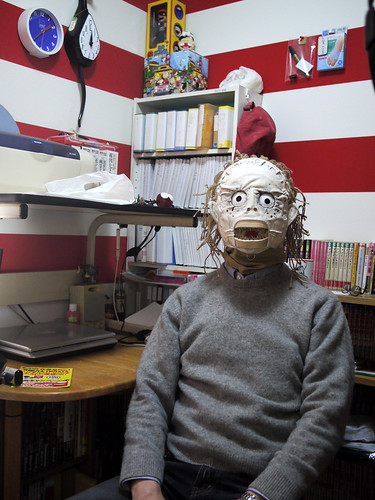
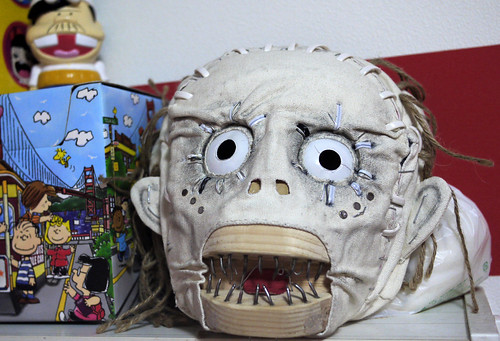
Gokicchi in his element rocking a homemade mask of Mokume, the demon doll from Negai, the short story from Umezu Kazuo.
Growing up forces us to relinquish the rights allowed only to a child—innocence, dreams, hidden bases—yet some of us manage to sneak through the rite of passage and emerge on the other side with an enviable part of our juvenile selves intact. Gokicchi, with his secret library that he still hides from his parents, is one such person.
Gokicchi lives with his wife and two daughters in the quiet suburbs of Chiba, an hour removed from Tokyo and its concrete anthills of activity. His home is pleasantly non-offensive in its sterility and adherence to prescribed societal norms—Giant flat screen TV roosting over the Wii (fun for the whole family), wooden silverware (much more welcoming than metal), muted colors and the sweet aroma of home cooked curry (savory and never overpowering). Yet like a Lynchian headtrip, the more idyllic the scene, the more stark its secrets.
One unassuming door in the back bedroom is all that stands between family life and a hidden life. Throw it open and step inside to a Showa-era time capsule that puts 20th Century Boys’ Tomodachi to shame.
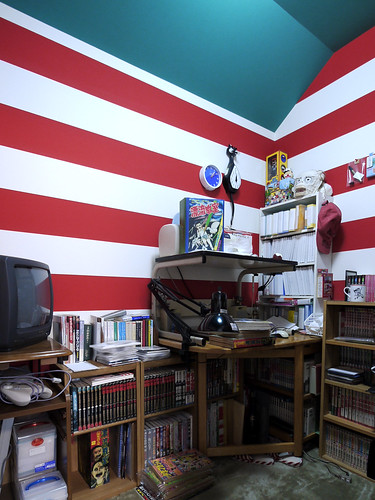
Red and white and insane all over, this room stands as a cultural bomb shelter, its shelves lined with classics from Tezuka, Shirato Sanpei, Yokoyama Mitsureru, but this is par for the course, the sort of titles that give balance to the eclectic pieces. And no one offers a better mix of the eclectic than horror master Umezu Kazuo, hence the artists’ trademark red and white striped motif lining the walls. The custom wallpaper, produced by the same interior designer behind the lawsuit-worthy funhouse in Kichijoji, hypnotically draws your eyes around the pill box and its bottomless bowls of hallucinogenic candy.
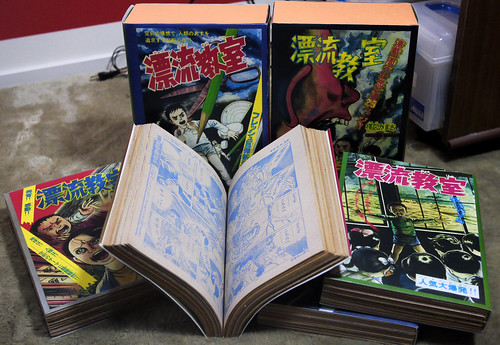
Manga anthologies are printed in an oversized phonebook format that is shrunk down to a pocket sized trade paperback, the difference between the two being the experience of enjoying a movie on a panoramic theater screen or making due with your cramped computer monitor. This fan-made collection of The Drifting Classroom represents the entire early 70’s run in Weekly Sunday transplanted and rebound so that the reader can drink in the series as it was originally serialized, complete with colorized pulp pages and politically incorrect dialogue which was edited in future releases.
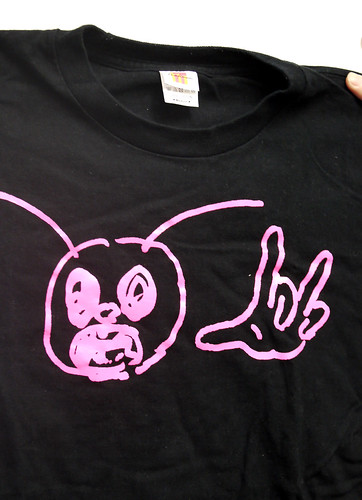
When the world can't cater to your tastes, you have to do your own cooking. Handmade T-Shirts are also a must for any Maniac. Gokkichi cribbed his name from the cockroach-human hybrid in Umezu Kazuo's dysotopic Sci-Fi thriller, Fourteen, who has been transferred from a signed shikishi to something closer to the owner's heart. Like any self respecting super hero, Gokicchi layers his trademark character under a button-up shirt and out of sight at public events, but is ready to bust it out at a moment's notice. Yeah, I'm
that Gokicchi. Bam!
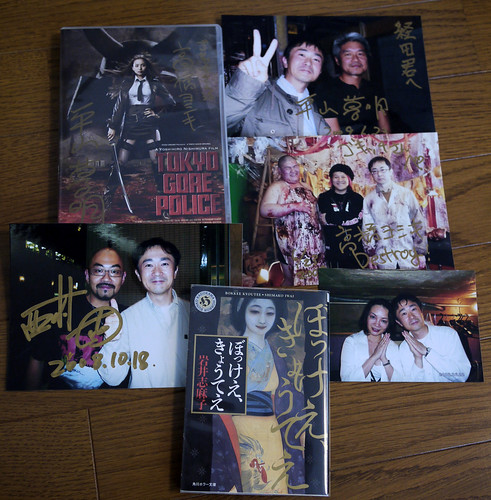
Gokicchi’s secret life has brought him together with the elite blackguard of the underground. He’s hobnobbed with Iwai Shimako, author of the novel that inspired Imprint, the Miike directed episode of Masters of Horror, had a cameo in Orochi as an audience member during the sisters’ singing recital, and served as a prop-making homunculus on the set of Tokyo Gore Police. Watch for him as the screen right skin grafter during the DVD extras commercial for an Ed Gein-style interior decorating service.
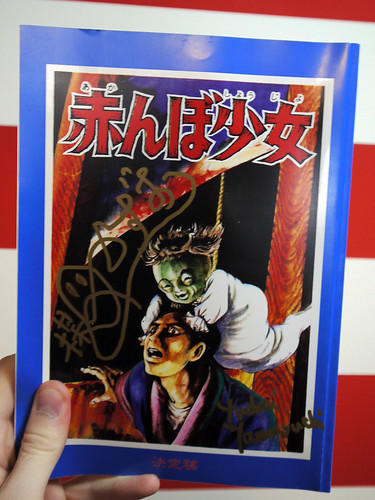 Being a popular schmoozer helps to get your hands on signed scripts, like this copy of Akanbo Shojo (Tamami: The Baby's Curse).
Finding What Makes Gokicchi Tick
TSB (T):
Being a popular schmoozer helps to get your hands on signed scripts, like this copy of Akanbo Shojo (Tamami: The Baby's Curse).
Finding What Makes Gokicchi Tick
TSB (T): What was your first scrape with horror?
Gokicchi (G): I was always a weird kid, way into grotesque books and movies, though it never led to me torturing animals or anything like that. My parents grew up with off-kilter authors such as Edogawa Rampo, so they never gave me any grief. If anything, they’re responsible for the way I turned out!
T: How did you get into Umezu Kazuo?
G: When I discovered Cat Eye Boy in the pages of Shonen King back in 1968 I become a fan. But I didn’t become a follower until 2006. After one of his events, his hand bumped into mine on the way out the door. He turned and apologized with the sincerest smile that I’d ever seen. I was stunned. Famous people always put their best face forward for the camera, but how many of them make that extra human effort?
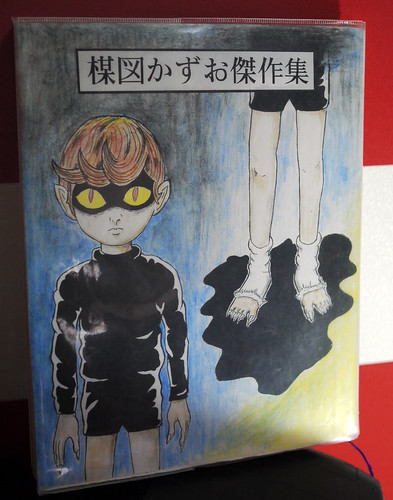 Following the example set by the rebound Drifting Classroom featured above, Gokicchi hunted down and binded several other original runs of Umezu manga himself.
T: What initially brought you to the event?
G: My daughters, inadvertently. They begged me to get a computer and I finally broke down in 2006, where the Internet brought me together with other fans. Umezu.com was a huge boon, and its message board helped me enter the fold. There’s other manga-ka that I like, but none of them have an official homepage to the same degree. Who knows? I might have ended up obsessing over a different author if they had gotten to me first.
Shonen Magazine: Devil Man #1 " height="500" width="375">
Shonen Magazine featuring the first issue of Devil Man. Gokicchi's latest project is scraping together the entire serial to rebind.
T: Have you pursued other famous people to the same degree as Umezu?
G: One of my buddies is a red carpet hound. He’d camp out the night before just for the chance to get a signature from a big foreign star. One day he called me up and asked if I wanted to join. Next thing I knew, I was hooked. You get sucked in by their star power. The rush you get in fighting other fans for the signature is exhilarating.
You need a game plan—Something to draw the actor’s attention. When Keanu Reeves came, everyone was waving copies of The Matrix. He was deadest on ignoring the crowd until I caught his eye with a copy of Point Break. Artists get a kick out of seeing their under-appreciated works recognized, especially in a foreign country!
The sad part is not being able to interact with them on a personal level. I mean, they’re celebrities, so it’s to be expected, but still. That’s why following people like Umezu is great. The artists know me, the other fans know me—It's a whole sub-community held together by a common interest and dedication.
That's the key: Have a game plan. Have a way to stay relevant in an increasingly homogenized world.
Gokicchi's collection contains many more oddities, the best of which are too damning to those who appear in them to be made public. I don' dare mention their content. Even if I did, the information is locked under such iron-clad protection by its keepers that it would be unsearchable. This is a mind-boggling concept in our modern society where the collective knowledge of mankind is at your fingertips while the thrill of discovery sleeps at your feet, sedated by the convent complacence of E-shopping.
Some information is still off the grid. The past still waits to be discovered. And as long as there is interest in the bizarre and unknown, we will need people like Gokicchi to light the way.
Find more photos of Gokicchi's awesome collection on our Flickr page.




